 ultimate-guide
How Long Does Laser Hair Removal Last? (2026 Guide)
Table of Contents
- How Long Does Laser Hair Removal Last? The Short Answer
- Is Laser Hair Removal Permanent? What Clinical Data Shows
- Factors That Influence How Long Results Last
- The Treatment Timeline: Sessions and Hair Growth Cycle
- Laser Hair Removal Maintenance Sessions: Your Long-Term Plan
- Laser Hair Removal Preparation: What to Do Before Each Session
- Cost-Benefit Analysis: Laser vs. Shaving and Waxing
- Conclusion: Setting Realistic Expectations and Next Steps
- Frequently Asked Questions
Last Updated: September 8, 2026
How Long Does Laser Hair Removal Last? The Short Answer
Most people see a significant reduction in hair growth that lasts for years, not a lifetime. For the majority of clients, laser hair removal results last anywhere from several months to multiple years, with many enjoying smooth skin for 2 to 5 years before noticing meaningful regrowth (PubMed). This is a hair reduction treatment, not a guarantee of zero hairs forever.
Laser hair removal permanently reduces hair in treated areas, but it doesn't stop new hair from ever appearing. Hormones, genetics, and aging can trigger new follicle activity years after your final session.
Is Laser Hair Removal Permanent? What Clinical Data Shows
Laser hair removal is best described as permanent hair reduction, a distinction the FDA uses to separate it from methods promising complete elimination (the FDA). The laser targets melanin in hair follicles, converting light energy into thermal damage that disrupts the follicle's ability to produce hair. Because the treatment only affects follicles in the active growth phase (anagen), multiple sessions are required to catch every hair at the right moment.
Clinical trials and long-term studies consistently show that treated areas maintain reduced hair density for extended periods. Many patients retain 70 to 90 percent reduction for several years after completing their initial series (peer-reviewed research).
Factors That Influence How Long Results Last
Several biological and technical factors determine whether you enjoy five years of smooth skin or notice regrowth within eighteen months. Skin type, hair color, treatment area, and practitioner skill all play significant roles. But two factors, your hormonal profile and the specific laser technology used, are the primary drivers of long-term success.
Hormonal Influence on Regrowth: The PCOS, Thyroid, and Pregnancy Connection
Hormonal fluctuations are the single biggest reason hair returns after successful laser treatment. Specific, common conditions have a direct and measurable impact on your results.
Polycystic Ovary Syndrome (PCOS) is the most significant hormonal factor. PCOS causes an overproduction of androgens, like testosterone, which stimulate hair follicles to grow thicker, darker hair in a male-pattern distribution (face, chest, abdomen). The laser successfully treats the hair present at the time of the session, but the underlying hyperandrogenism continues to signal new follicles to activate. Women with PCOS often see excellent results during their initial series, but experience noticeable regrowth within 6 to 12 months if their condition is not otherwise managed.
Thyroid Imbalances (both hypothyroidism and hyperthyroidism) can also disrupt the hair growth cycle, causing changes in body hair texture and growth patterns that make regrowth after laser unpredictable.
Pregnancy and Menopause represent massive hormonal shifts. During pregnancy, elevated estrogen and progesterone can prolong the anagen phase, meaning more hairs are active and susceptible to laser damage. However, the postpartum hormone crash can trigger telogen effluvium, making results appear to 'fail' months later when the hair is just cycling. Menopause, with its declining estrogen and shifting androgen ratios, can cause new, coarse hair on the chin and upper lip, requiring a new series of treatments in areas that were previously clear.
Skin Tone and Hair Color Variables: The Melanin Physics
The ideal candidate for laser hair removal has light skin and dark, coarse hair, because the laser needs contrast to target melanin in the follicle without damaging surrounding skin. The laser's effectiveness and safety are determined by the interaction between two types of melanin: eumelanin (dark brown/black pigment) and pheomelanin (red/yellow pigment).
Lasers are tuned to wavelengths preferentially absorbed by eumelanin, which is why black and dark brown hair responds best. Red hair, primarily pheomelanin, does not absorb the laser energy effectively, which is why results are often poor. Blonde, gray, and white hair have very little eumelanin, making them nearly impossible to treat with standard lasers.
On the skin side, the challenge is epidermal melanin. The laser must pass through the skin to reach the follicle. If your skin has high levels of melanin (Fitzpatrick skin types IV-VI), it competes with the hair follicle for the laser's energy, raising the risk of burns, hyperpigmentation, and hypopigmentation.
Modern lasers have addressed this with longer wavelengths and pulse durations. The Nd:YAG laser (1064 nm) penetrates deeper and is less absorbed by epidermal melanin, making it the safest and most effective choice for darker skin. The Alexandrite laser (755 nm) is more effective on lighter skin types because its shorter wavelength is more readily absorbed by the hair's eumelanin, but carries a higher risk of pigment changes in darker skin. The Diode laser (800-810 nm) sits in between, offering a good balance of efficacy and safety across a wider range of skin types.
A consultation with a qualified professional is essential to determine your Fitzpatrick skin type and hair color profile before you invest in a package. A provider who does not ask about your family history of PCOS or thyroid issues, or who cannot explain why they are choosing a specific laser wavelength for your skin, is not giving you the full picture.
The Treatment Timeline: Sessions and Hair Growth Cycle
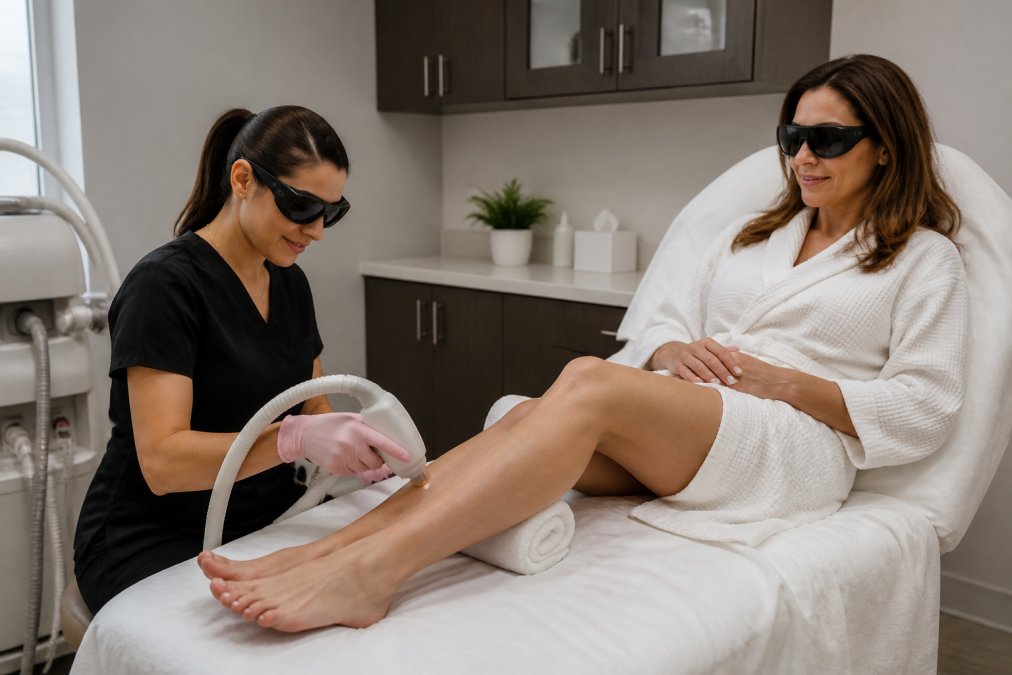
Hair grows in three phases: anagen (active growth), catagen (transitional), and telogen (resting before shedding). Laser energy only destroys follicles in the anagen phase, which is why a single session cannot remove all your hair. At any given moment, only 15 to 30 percent of your follicles are actively growing, depending on the body area.
A typical treatment plan requires 6 to 9 sessions spaced 6 weeks apart for the first 6 treatments then extended to 12 weeks. This spacing aligns each session with the next wave of follicles entering the anagen phase. You will notice progressive thinning after each visit, with the most dramatic results appearing after your third or fourth session.
However, at Elite Laser Center we offer the Elite Laser Hair Removal Packages. The package includes the first 9 treatments that you pay for, we then provide up to 9 more treatments over the remaining months to get to where you are satisfied with the results. The package extends your treatments over 36 months from the first treatment. We are the only Laser Hair Removal that offers this service
Treatment Area | Typical Sessions | Interval Between Sessions | Expected Timeline |
|---|---|---|---|
Upper lip | 6 to 9 | 6 weeks for first 6 treatments then 12 weeks | 9 to 36 months |
Underarms | 6 to 9 | 6 weeks for first 6 treatments then 12 weeks | 9 to 36 months |
Bikini line | 6 to 9 | 6 weeks for first 6 treatments then 12 weeks | 9 to 36 months |
Legs | 6 to 9 | 6 weeks for first 6 treatments then 12 weeks | 9 to 36 months |
Back or chest | 6 to 9 | 6 weeks for first 6 treatments then 12 weeks | 9 to 36 months |
Sessions themselves are quick. Upper lip treatments take under five minutes, while full legs can take up to an hour. Most clients describe the sensation as a rubber band snapping against the skin, and modern devices include cooling mechanisms that keep discomfort minimal.
Laser Hair Removal Maintenance Sessions: Your Long-Term Plan
After completing your initial series, plan on maintenance sessions to address the slow regrowth that hormonal shifts and aging naturally trigger. Most clients need one touch-up session every 1 to 2 years to maintain smooth results, though this varies widely by person and treatment area.
How Your Laser Choice Affects Your Maintenance Schedule
The type of laser used during your initial series has a direct impact on how long you stay smooth.
Alexandrite Lasers (755 nm) are highly effective on light skin with dark hair. Because this wavelength is so strongly absorbed by melanin, it can deliver a very high-energy dose to the follicle, often resulting in more complete destruction of the hair bulb. Clients treated with a high-quality Alexandrite laser often report the longest intervals between maintenance sessions, sometimes 2 to 3 years or more, because the follicle damage is more thorough.
Diode Lasers (800-810 nm) offer deeper penetration and are effective on a broader range of skin types than Alexandrite. However, because the energy is distributed over a slightly larger volume of tissue, the per-follicle damage can be slightly less intense. In practice, results are excellent, but maintenance sessions may be needed slightly more frequently, typically every 12 to 18 months, to catch finer, delayed regrowth.
Nd:YAG Lasers (1064 nm) are the go-to for darker skin tones (Fitzpatrick IV-VI). The longer wavelength bypasses the epidermal melanin to target the follicle deeper in the dermis. This is safer, but often requires higher energy settings to achieve the same level of follicle damage as an Alexandrite on lighter skin. As a result, clients with darker skin treated with Nd:YAG may need maintenance sessions on the more frequent end of the spectrum, perhaps every 9 to 12 months, to maintain the same level of smoothness.
The Biology of Regrowth: Why 'One and Done' Fails
A common mistake is treating the initial package as a one-and-done expense. Maintenance is necessary not because the laser 'wears off,' but because you are fighting a biological process. The laser destroys the mature follicle actively producing a hair at the time of treatment. However, stem cells in the bulge region of the follicle can survive and, when stimulated by a new hormonal signal or the natural aging process, can regenerate a new, often finer, hair follicle.
This is why regrowth years later is typically not the same coarse hair you started with. It's often vellus-like (peach fuzz) or a lighter, thinner intermediate hair, a sign that the laser destroyed the robust, hormone-sensitive follicle, but a less active one has taken its place. A single maintenance session with the same laser technology is usually enough to destroy this weaker follicle, restoring your smooth results for another extended period.
The Cost of Skipping Maintenance
Skipping maintenance sessions is a false economy. If you let regrowth go for 3 to 4 years, the fine, sparse hairs may have been gradually stimulated by hormones and thickened back up. At that point, a single touch-up session may not be enough, you could need a mini-series of 2 to 3 sessions to get back to your post-initial-series baseline.
Laser hair removal maintenance sessions are an ongoing cost, similar to annual skin checks with a dermatologist. By understanding the technology behind your treatment and the biology of your regrowth, you can plan a maintenance schedule that is both effective and budget-friendly.
Laser Hair Removal Preparation: What to Do Before Each Session
Proper preparation directly affects how well your treatment works and how comfortable you are during it. Stop plucking, waxing, and electrolysis for at least 4 to 6 weeks before your session, these methods remove the hair root, which means the laser has nothing to target. Shaving is the only acceptable method between sessions because it leaves the follicle intact beneath the surface.
Avoid sun exposure and tanning beds for at least two weeks prior to treatment, tanned skin absorbs more laser energy, increasing the risk of burns and pigmentation changes. On the day of your appointment, arrive with clean, dry skin, free of lotions, deodorants, and makeup in the treatment area.
Cost-Benefit Analysis: Laser vs. Shaving and Waxing
The upfront cost of laser hair removal is higher than a razor or a waxing appointment, but the long-term math favors laser for most people. Shaving requires ongoing purchases of razors and shaving cream, plus daily or weekly time commitments. Waxing appointments repeat every 4 to 6 weeks, forever, with each visit carrying a comparable price to a single laser session.
Over a 5 to 10 year horizon, the cumulative cost of waxing or high-end shaving routines often exceeds the total investment in a laser package plus periodic maintenance.
Conclusion: Setting Realistic Expectations and Next Steps
Laser hair removal is one of the most effective long-term solutions for unwanted hair, but it is not magic. Expect permanent hair reduction, not elimination. Plan for an initial series of 6 to 8 sessions, then budget for a maintenance visit every year or two. Understand that your hormones and skin type will influence your personal timeline, and choose a provider with the technology and experience to treat your specific profile safely.
If you are ready to stop the cycle of shaving and waxing, schedule a consultation and find out how long your smooth results can last.
The decision to pursue laser hair removal is a personal one, and the range of possible outcomes can feel overwhelming. You want a provider who gives you straight answers, uses advanced FDA-cleared technology, and stands behind their work with a real guarantee. Elite Laser Center Medical Spa combines over 20 years of experience with nurse-performed treatments and a 3-year guarantee on laser packages. Schedule a consultation and take the first step toward long-lasting hair reduction.
Frequently Asked Questions
Will laser hair removal last forever?
Laser hair removal provides permanent hair reduction, not permanent removal in most cases. It destroys hair follicles in the active growth phase, which significantly reduces hair density and regrowth. Many people see results lasting for years. However, hormonal changes or new hair follicles can lead to some regrowth over time, which is why maintenance sessions are often recommended to keep the area smooth.
How many laser hair removal sessions are typically needed?
Most people need 6 to 8 sessions to achieve their desired level of hair reduction. This is because laser treatment only affects hair follicles in the active growth (anagen) phase. Since not all hairs are in this phase at once, multiple sessions spaced several weeks apart are required to target each follicle. Your treatment plan should be personalized based on your hair color, skin type, and the treatment area.
What factors influence how long laser hair removal results last?
The longevity of your results depends on several key factors. Hormonal fluctuations from pregnancy, menopause, or conditions like PCOS can stimulate new hair growth. Your natural hair color and skin tone also matter, as the laser targets the pigment in the hair follicle. The technology used and the experience of your provider are critical. Finally, following a proper maintenance schedule helps sustain your results over the long term.
Do I need maintenance sessions after laser hair removal?
Many people benefit from occasional laser hair removal maintenance sessions. After your initial treatment series, you may see some regrowth months or even years later, often due to hormonal shifts. A single touch-up session once a year or every other year is usually enough to catch new follicles and maintain smooth skin. Your provider can recommend a schedule based on how your hair responds to the initial treatments.