 how-to
Laser Hair Removal on Dark Skin: Complete Guide
Table of Contents
- Why Laser Hair Removal on Dark Skin Requires Specialized Technology
- How the Nd:YAG Laser for Hair Removal Works on Melanin-Rich Skin
- Preparing for Laser Hair Removal: Pre-Treatment Steps for Dark Skin
- What to Expect During Your Laser Hair Removal Treatment
- Laser Hair Removal Aftercare for Dark Skin Tones
- Laser Hair Removal Side Effects on Dark Skin: Prevention and Management
- Hair Growth Cycles and Treatment Intervals for Optimal Results
- Hormonal Factors and Laser Efficacy on Dark Skin
- Frequently Asked Questions
Last Updated: September 20, 2026
Why Laser Hair Removal on Dark Skin Requires Specialized Technology
Standard laser equipment designed for lighter skin can cause burns, hyperpigmentation, and uneven results on melanin-rich skin. This is why laser hair removal dark skin requires specialized technology and expertise that not all clinics possess.
Darker skin contains more epidermal melanin, which absorbs laser energy intensely. A laser setting safe for fair skin can overheat the skin's surface, causing thermal damage before reaching the hair follicle. The Nd:YAG laser operates at a longer wavelength that penetrates deeper, bypassing surface melanin to target the hair directly.
How the Nd:YAG Laser for Hair Removal Works on Melanin-Rich Skin
The Nd:YAG laser operates at 1064 nanometers wavelength for laser hair removal dark skin treatment. This longer wavelength passes through surface melanin and reaches the hair follicle deeper in the skin, destroying it without overheating the surface.
Shorter-wavelength lasers (like alexandrite at 755nm) are absorbed by surface melanin, trapping energy before it reaches the hair and causing surface burns and hyperpigmentation on dark skin.
The Nd:YAG has less affinity for melanin, penetrating deeper to reach the hair follicle while leaving surface melanin unaffected. The follicle absorbs the energy and dies while the skin stays safe.
Understanding Fitzpatrick Skin Phototypes and Melanin Absorption
Fitzpatrick skin phototypes classify skin from Type I (very fair) to Type VI (very dark). Your type determines which laser settings are safe and effective for you.
Types IV-VI have progressively higher melanin content and absorb laser energy more aggressively. A setting safe for Type II skin can cause burns on Type V skin.
For Types IV-VI, the Nd:YAG laser is not just preferred, it's necessary. This laser's longer wavelength means it bypasses the high melanin concentration in your epidermis and targets the hair follicle directly. Clinics that use only shorter-wavelength lasers should not treat dark skin. Period.
Long-Pulsed Nd:YAG vs. Other Laser Types
Long-pulsed Nd:YAG is the variant used for dark skin hair removal. Longer pulses spread heat into the hair follicle without concentrating energy at the skin surface.
Other laser types used for hair removal include:
- Alexandrite (755nm): Shorter wavelength, better for lighter skin (Types I-III). Not recommended for dark skin.
- Diode (810nm): Medium wavelength, works on some darker skin types but less safe than Nd:YAG.
- Ruby (694nm): Shortest wavelength, rarely used today. Poor choice for dark skin.
Long-pulsed Nd:YAG is the gold standard for dark skin because it combines safety with efficacy, allowing lower fluence to reduce burn risk while destroying the hair follicle.
Preparing for Laser Hair Removal: Pre-Treatment Steps for Dark Skin
What you do in the two weeks before your appointment directly affects safety and results. Sun exposure increases hyperpigmentation risk and reduces effectiveness.
Patch Testing and Skin Assessment
A patch test uses the laser on a small, hidden area at planned settings, then waits 24 hours to assess your skin's response. This is non-negotiable.
The patch test reveals how your skin reacts to the laser settings, whether you're prone to hyperpigmentation or hypopigmentation, and the appropriate fluence level for your skin tone and hair type.
Your provider will assess your baseline skin tone, existing scars or moles, photosensitizing medications, and hair growth cycle to create a personalized treatment plan.
Sun Exposure and Skincare Adjustments
Sun exposure before treatment is the biggest mistake. Even one day in the sun darkens your skin and increases hyperpigmentation risk.
For two weeks before your appointment: avoid direct sun exposure, wear SPF 30+ if outside, skip tanning beds and self-tanners, avoid exfoliants and retinoids, and do not wax or pluck. Arrive with your baseline skin tone to allow safe laser parameters.
What to Expect During Your Laser Hair Removal Treatment
Laser hair removal on dark skin tones takes 15-30 minutes per area. You'll wear protective eyewear in a clinical room with the laser device and cooling system.
Your provider applies cooling gel to transmit laser energy efficiently and prevent burns. Modern Nd:YAG devices have built-in cooling that activates before and after each pulse.
The laser fires with a snapping sensation lasting milliseconds. It targets dark pigment in the hair follicle, heating it to destroy the follicle's ability to grow hair.
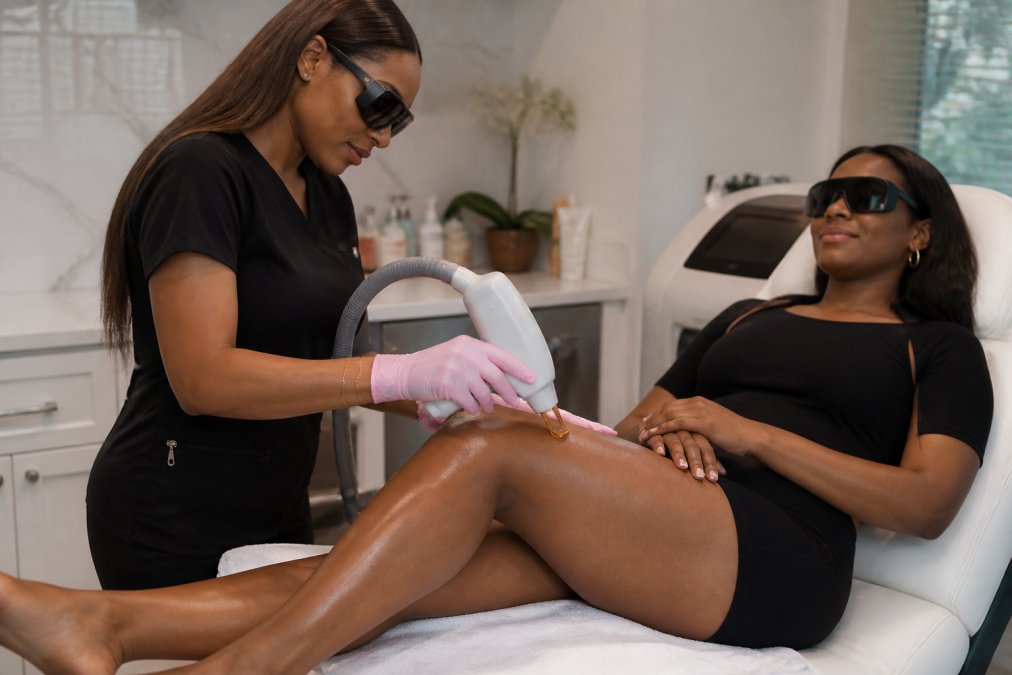
Your provider works methodically across the area with lower fluence, longer pulse duration, and aggressive cooling to prevent thermal damage on dark skin.
Laser Settings and Cooling Systems for Safety
On dark skin, critical settings include lower fluence, longer pulse duration, longer intervals between pulses, and aggressive cooling before and after each pulse.
The cooling system reduces pain and prevents burns. Modern Nd:YAG devices cool skin to 5-10°C before firing, protecting the epidermis while laser energy reaches the hair follicle.
Laser Hair Removal Aftercare for Dark Skin Tones
What you do in the 48 hours after treatment determines whether you heal cleanly. Your skin will be warm, slightly red, and more sensitive.
Managing Hyperpigmentation and Hypopigmentation Risk
Hyperpigmentation (dark spots) is the most common side effect on dark skin, occurring when skin produces extra melanin in response to treatment. It usually fades over weeks to months.
Long-Term Maintenance and Touch-Up Frequency
Laser hair removal is long-lasting, with most people seeing 80-90% hair reduction after a series of treatments. Some hair regrows because not every follicle is in the growth phase during treatment.
Laser Hair Removal Side Effects on Dark Skin: Prevention and Management
Dark skin is at higher risk for certain side effects if the wrong laser or settings are used. Understanding these risks and how to prevent them is essential.
Burn Risk and Thermal Damage Prevention
Burns happen when laser energy concentrates at the skin surface instead of reaching the hair follicle. On dark skin, this risk increases because melanin absorbs laser energy readily. Using a shorter-wavelength laser or too-high fluence on dark skin is the primary cause.
Signs of a burn:
- Blistering or open wounds immediately after treatment
- Severe pain (beyond the normal snapping sensation)
- Dark scabs forming within 24 hours
- Skin peeling excessively
Post-Inflammatory Hyperpigmentation and How to Avoid It
Post-inflammatory hyperpigmentation (PIH) is darkening that occurs as the skin heals from treatment. It's not a burn, it's the skin's natural response to inflammation. On dark skin, PIH is more common than on light skin because melanocytes are more reactive.
- Sun protection (broad-spectrum SPF 30+ daily)
- Avoiding irritating skincare (retinoids, acids, vitamin C serums)
- Not picking at or scratching treated skin
- Using hydrating, soothing products (ceramides, niacinamide, centella asiatica)
Hair Growth Cycles and Treatment Intervals for Optimal Results
Hair doesn't grow continuously. It cycles through three phases: anagen (growth), catagen (transition), and telogen (resting). Only hair in the anagen phase has an active follicle that the laser can destroy.
Typical treatment spacing:
- Weeks 1-6: Treatments spaced 4-6 weeks apart (follicles cycle quickly in early phase)
- Weeks 7-12: Treatments spaced 6-8 weeks apart (cycle slows as follicles are destroyed)
- After 12 weeks: Treatments spaced 8-12 weeks apart (fewer active follicles remain)
Hormonal Factors and Laser Efficacy on Dark Skin
Hormones drive hair growth. Conditions like polycystic ovary syndrome (PCOS), thyroid disorders, and menopause increase circulating androgens, which stimulate hair follicles. If you have a hormonal condition, laser hair removal still works, but you'll need more frequent maintenance.
- Whether hormonal treatment (like birth control) might help reduce new hair growth
- More frequent maintenance treatments (every 6 months instead of yearly)
- Realistic expectations about permanent reduction versus long-term management
Frequently Asked Questions
Is laser hair removal safe for all skin tones, especially dark skin?
Yes, laser hair removal is safe for dark skin when performed with the correct technology and settings. The Nd:YAG laser is specifically designed for melanin-rich skin because its longer wavelength penetrates deeper without causing excess heat at the skin's surface. A qualified provider adjusts laser settings, fluence, and pulse duration based on your Fitzpatrick skin phototype to minimize burn risk and side effects. Patch testing before full treatment is essential to confirm your skin's response.
What type of laser is best for dark skin tones?
The long-pulsed Nd:YAG laser is the gold standard for dark skin. Unlike shorter-wavelength lasers that absorb too much melanin at the epidermis, the Nd:YAG laser's 1064-nanometer wavelength targets the hair follicle directly while sparing surrounding tissue. This reduces the risk of hyperpigmentation, hypopigmentation, and thermal burns. Ensure your provider uses FDA-cleared Nd:YAG equipment and has experience treating melanin-rich skin.
How many sessions does laser hair removal take on dark skin?
Most people need 6 to 12 sessions spaced 4 to 8 weeks apart for significant hair reduction on dark skin. Results depend on hair density, growth cycle, and hormonal factors. During the anagen (active growth) phase, hair is most responsive to laser treatment. Your provider will assess progress at each visit and recommend touch-up sessions based on regrowth. Elite Laser Center offers a 3-year guarantee on all laser hair removal packages.
Can hormonal conditions like PCOS affect laser hair removal results?
Yes, conditions that increase androgen levels, such as PCOS, can stimulate new hair growth even after successful laser treatment. Laser hair removal reduces existing hair effectively, but hormonal imbalances may cause regrowth over time. Discuss your medical history during your consultation so your provider can set realistic expectations and recommend appropriate treatment intervals and maintenance plans tailored to your condition.